Matching measures
functions, such as Exact, Levenshtein and
Jaro-Winkler, or a custom matching algorithm you
created.
You can also compare two records on many attributes. For two records to match, the two
following conditions must hold:
-
When using the T-Swoosh algorithm, the score for each matching function in the
match rule must exceed the threshold, if any specified. By default, the
threshold is set to 1. This means exact match for most
matching functions, excepted for Exact – ignore case and
potentially any custom matching function. -
The global score, computed as a weighted score of the different matching
functions, must exceed the match threshold. The score is equal to
Σ(wi ×
si(r1,r2)) / Σwi where
wi is the confidence
weight of the matching function i and
si(r1,r2)
is the score of the matching function i over
records r1 and
r2.

In this example, the score for the Levenshtein metric on the
attribute country must exceed 0.7 and
the global score, with a confidence weight of 1 on each of
the two measures, must exceed 0.85.
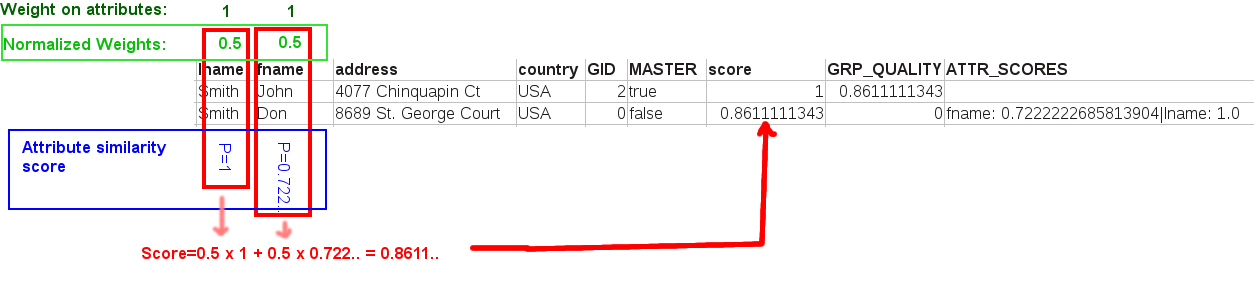
This example shows the weighted average computation that yields the global score of
two similar records.