tNLPPredict
Uses a classifier model generated by tNLPModel to predict and
label the input text.
tNLPPredict outputs labeled text and the labels for tokens in two
separate columns.
This component can run only with Spark 1.6.
tNLPPredict properties for Apache Spark Batch
These properties are used to configure tNLPPredict running in
the Spark Batch Job framework.
The Spark Batch
tNLPPredict component belongs to the Natural Language Processing family.
The component in this framework is available when you have subscribed to any Talend Platform product with Big Data or Talend Data
Fabric.
Basic settings
|
Schema and Edit Schema |
A schema is a row description. It defines the number of fields (columns) to Click Sync columns to retrieve the schema from Click Edit schema to make changes to the schema.
Read-only columns are added to the output schema:
|
|
|
Built-In: You create and store the |
|
|
Repository: You have already created |
|
Define a storage configuration component |
Select the configuration component to be used to provide the configuration If you leave this check box clear, the target file system is the local The configuration component to be used must be present in the same Job. For |
|
Original text column |
Select the column to be labeled in the input schema. |
|
Token column |
Select the column used for feature construction and prediction. |
|
Additional Features |
Select this check box to add additional features to the When you add features, the order must be the same as the additional |
|
NLP model path |
Set the path to the local folder from where you want to retrieve the If you want to store the model in a specific file system, for example S3 The button for browsing does not work with the Spark Local mode; if you are using the Spark Yarn or the Spark Standalone mode, |
Usage
|
Usage rule |
This component is used as an intermediate step. This component, along with the Spark Batch component Palette it belongs to, appears only |
|
Spark Batch Connection |
You need to use the Spark Configuration tab in
the Run view to define the connection to a given Spark cluster for the whole Job. In addition, since the Job expects its dependent jar files for execution, you must specify the directory in the file system to which these jar files are transferred so that Spark can access these files:
This connection is effective on a per-Job basis. |
Scenario: Extracting named entities using a classification model
This scenario applies only to a subscription-based Talend Platform solution with Big data or Talend Data Fabric.
The tNLPPredict component predicts and automatically labels named
entities using a classification model generated by the tNLPModel
component.
You can find more information about natural language processing on
Talend Help Center (https://help.talend.com).
Creating a Job to extract named entities from text data
automatically labels text data divided into tokens, using a classification
model.
-
Drop the following components from the Palette onto the
design workspace: tMySQLInput,
tNLPPredict, tFilterColumns
and tFileOutputDelimited. - Connect the components using Row > Main connections.

Configuring the input component
database.
-
Double click the tMysqlInput component to open its
Basic settings view and define its properties.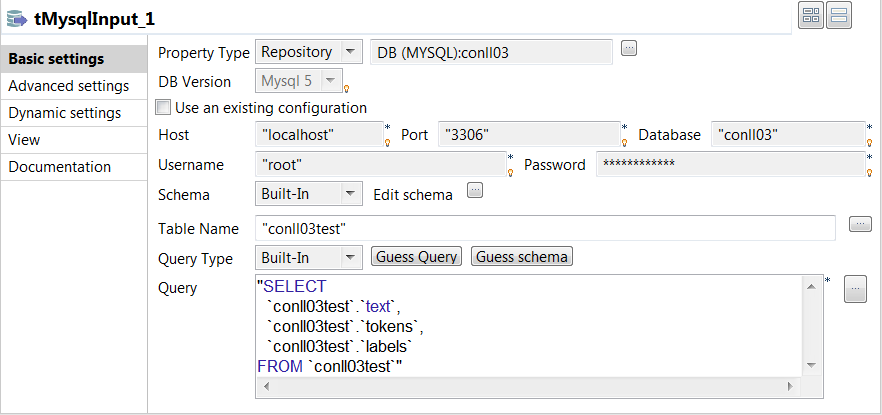
-
From the Property Type list, select
Repository if you have already stored the connection
to database in the Metadata node of the Repository tree view. The property
fields that follow are automatically filled in. -
Set the Schema as Built-in and click Edit
schema to define the desired schema.In this example, three columns are added to the schema:
text, tokens and
labels. -
Set the Query Type as Built-In.
In the Query box, enter the query required to retrieve
the desired columns from the table.
Extracting named entities from text data
and automatically labels text data, using a classification model generated by the
tNLPModel component.
-
Double click the tNLPPredict component to open its
Basic settings view and define its properties.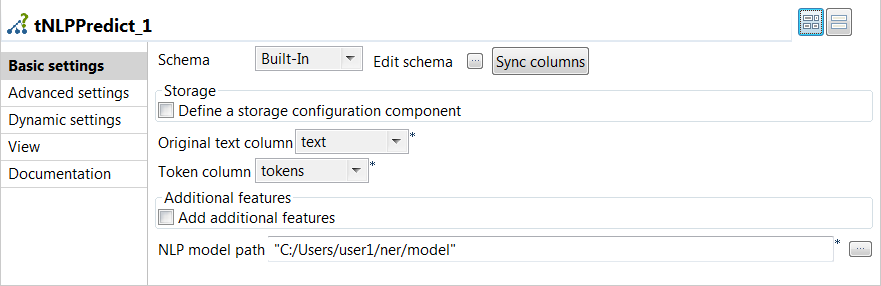
-
Click Sync columns to retrieve the
schema from the previous component connected in the Job.
-
From the Original text column list, select the
column that holds the text to be labeled, which is
text in this example. -
From the Token column list, select the column
used for feature construction and prediction, which is
tokens in this example -
From the NLP Library list, select the same
library you used for generating the model. -
Specify the path to the named entity recognition model in the
NLP model path.
-
-
Double click the tFilterColumns component to open its
Basic settings view and define its properties.-
Click Sync columns to retrieve the
schema from the previous component connected in the Job.
-
Set the Schema as Built-in and click
Edit schema to keep only the columns that
hold the original text, the labeled text and the labels.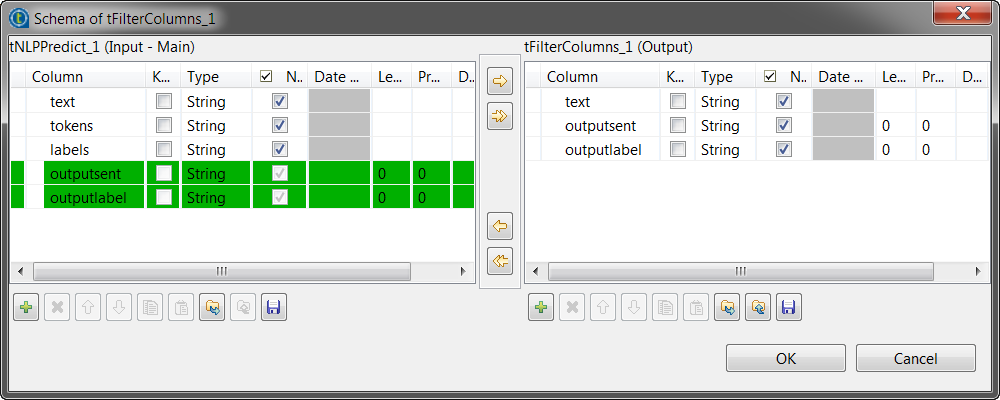
-
-
Double click the tFileOutputDelimited component to open
its Basic settings view and define its properties.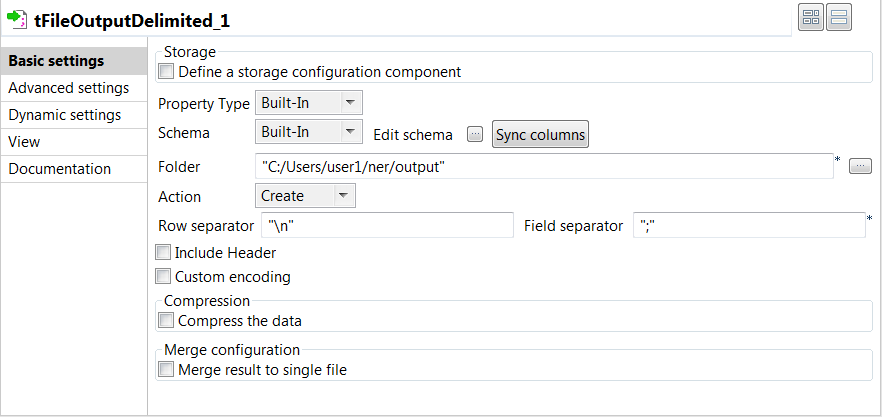
-
Click Sync columns to retrieve the
schema from the previous component connected in the Job.
-
Specify the path to the folder where you want to store the labeled text
and the labels, in the Folder field. -
Enter "
" in the Row
separator field and ";" in the
Field separator field.
-
-
Press F6 to save and execute the
Job.
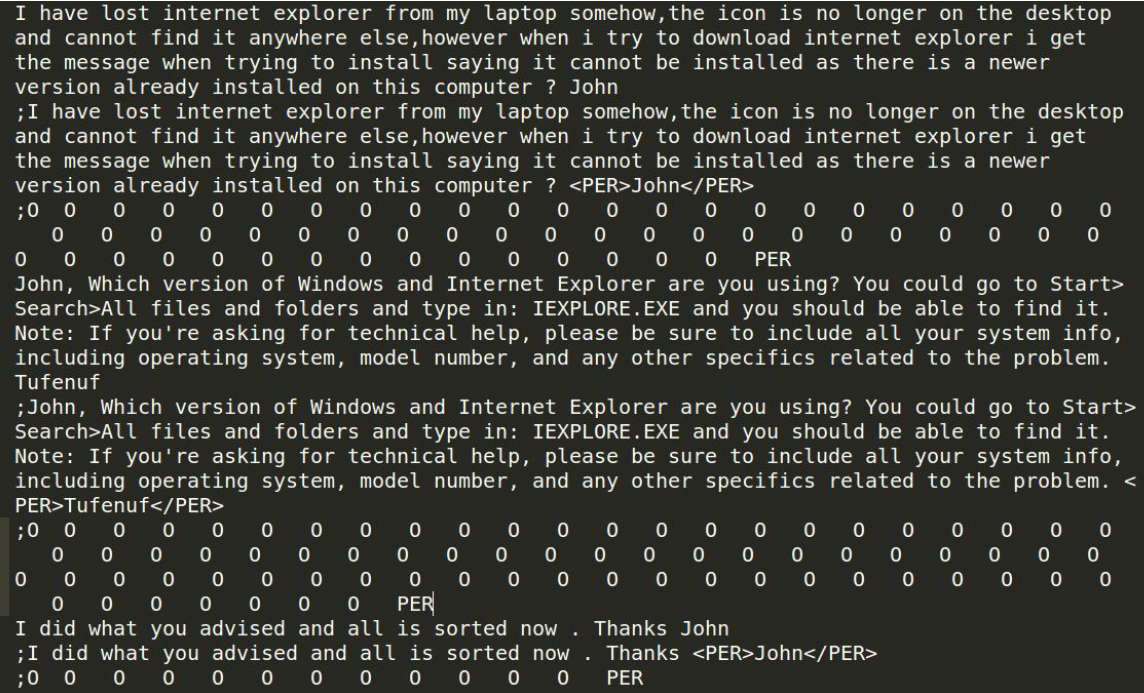
The output files contain the original text, the labeled text and the labels. The
named entity recognition task was performed correctly, since person names were
extracted from the original text.