tSPSSOutput
Writes or appends data to an SPSS .sav file. It creates SPSS files on the fly and
overwrites existing ones.
tSPSSOutput writes data entries in an .sav
file.
tSPSSOutput Standard properties
These properties are used to configure tSPSSOutput running in the Standard Job framework.
The Standard
tSPSSOutput component belongs to the Business Intelligence family.
The component in this framework is generally available.
Basic settings
|
Sync schema |
Click this button to synchronize with the columns of the SPSS .sav file. |
|
Schema and Edit Schema |
A schema is a row description. It defines the number of fields (columns) to Click Edit schema to make changes to the schema.
|
|
|
Built-in: The schema is created and stored |
|
|
Repository: The schema already exists and is |
|
Filename |
Name or path of the SPSS .sav file to be written. |
|
Write Type |
Select an operation from the list: Write: simply writes the new data.
Append: writes the new data at the end of the |
Advanced settings
|
tStat |
Select this check box to collect log data at the component level. |
Global Variables
|
Global Variables |
NB_LINE: the number of rows read by an input component or
ERROR_MESSAGE: the error message generated by the A Flow variable functions during the execution of a component while an After variable To fill up a field or expression with a variable, press Ctrl + For further information about variables, see |
Usage
|
Usage rule |
This component can not be used as start component. It requires an input Warning:
Before being able to benefit from all functional objectives of the SPSS |
|
Limitation |
Oracle provides two kinds of JVM platforms (32-bit and 64-bit). By default, the To do so, perform the following:
|
Scenario: Writing data in an .sav file
This Java scenario describes a very simple Job that writes data entries in an .sav
file.
Setting up the Job
- Drop a tRowGenerator component and a tSPSSOutput component from the Palette onto the design workspace.
-
Right-click on tRowGenerator and connect it to
tSPSSOutput using a Main
Row link.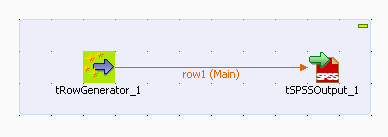
Configuring the input component
-
In the design workspace, double click tRowGenerator
to display its Basic Settings view and open its editor.
Here you can define your schema.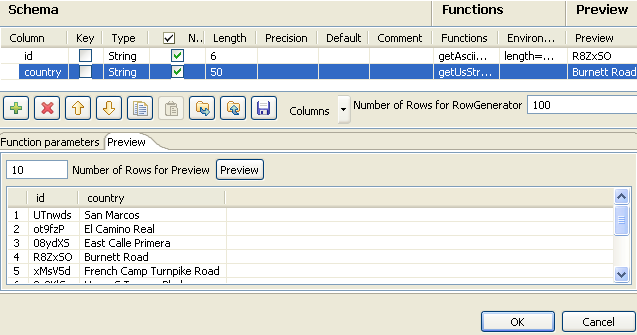
- Click the plus button to add the columns you want to write in the .sav file.
-
Define the schema and set the parameters to the columns.
Warning:
Make sure to define the length of your columns. Otherwise, an error
message will display when building your Job. -
Click OK to validate your schema and close the
editor.
Configuring the output component
-
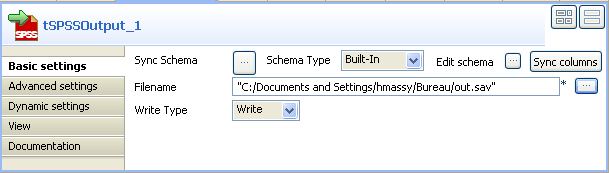
Click tSPSSOutput to display its Basic settings view and define the component properties.
-
Click the three-dot button next to the Filename
field and browse to the SPSS .sav file in which you want to write data. -
Click the three-dot button next to Sync columns to
synchronize columns with the previous component. In this example, the schema to be
inserted in the .sav file consists of the two columns: id and
country. -
If required, click Edit schema to view/edit the
defined schema. -
From the Write Type list, select Write or Append to simply
write the input data in the .sav file or add it to the end of the .sav file.
Job execution
Save the Job and press F6 to execute it.
The data generated by the tRowGenerator component is
written in the defined .sav file.