August 16, 2023

tSqoopMerge – Docs for ESB 6.x

tSqoopMerge

Performs an incremental import that updates an older dataset with newer records.
The file types of the newer and the older datasets must be the same.

tSqoopMerge reads two datasets in
HDFS and combines them both using a merge class that is able to parse the datasets, with
the newer records overwriting the older records.

Note:

Sqoop is typically installed in every Hadoop distribution. But if the Hadoop
distribution you need to use have no Sqoop installed, you have to install one on your
own and ensure to add the Sqoop command line to the PATH variable of that distribution.
For further information about how to install Sqoop, see the documentation of
Sqoop.

tSqoopMerge Standard properties

These properties are used to configure tSqoopMerge running in the Standard Job framework.

The Standard
tSqoopMerge component belongs to the Big Data and the File families.

The component in this framework is available when you are using one of the Talend solutions with Big Data.

Basic settings

Mode

Select the mode in which Sqoop is called in a Job execution.

Use Commandline: the Sqoop shell is used to call Sqoop. In
this mode, you have to deploy and run the Job in the host where Sqoop is installed.
Therefore, if you are a subscription-based user, we recommend installing and using a
Jobserver provided by
Talend
in that host to run the Job; if you are using one of the

Talend
solutions
with Big Data, you have to ensure that the Studio and the Sqoop to be used are in the same
machine.

Use Java API: the Java API is used to call Sqoop. In this
mode, the Job can be run locally in the Studio but you need to configure the connection to
the Hadoop distribution to be used. Note that JDK is required to execute the Job in the Java
API mode and the versions of the JDK kits installed in both machines must be compatible with
each other; for example, the versions are the same or the JDK version of the Hadoop machine
is more recent.

Hadoop properties

Either Built-in or Repository:

  • Built-in: you enter the configuration
    information of the Hadoop distribution to be used locally for this component
    only.

  • Repository: you have already created the
    Hadoop connection and stored it in the Repository; therefore, you reuse it directly for the component
    configuration and the Job design. For further information about how to create a
    centralized Hadoop connection, see
    Talend Open Studio for Big Data Getting Started
    Guide

    .

Distribution

Select the cluster you are using from the drop-down list. The options in the
list vary depending on the component you are using. Among these options, the following
ones requires specific configuration:

  • If available in this Distribution drop-down list, the Microsoft HD Insight option allows you to
    use a Microsoft HD Insight cluster. For this purpose, you need to configure
    the connections to the WebHCat service, the HD Insight service and the
    Windows Azure Storage service of that cluster in the areas that are
    displayed. A demonstration video about how to configure this connection is
    available in the following link: https://www.youtube.com/watch?v=A3QTT6VsNoM.

  • If you select Amazon
    EMR
    , you can find more details about how
    to configure an Amazon EMR cluster in Talend Help Center (https://help.talend.com)
    .

  • The Custom option
    allows you to connect to a cluster different from any of the distributions
    given in this list, that is to say, to connect to a cluster not officially
    supported by
    Talend
    .

  1. Select Import from existing
    version
    to import an officially supported distribution as base
    and then add other required jar files which the base distribution does not
    provide.

  2. Select Import from zip to
    import the configuration zip for the custom distribution to be used. This zip
    file should contain the libraries of the different Hadoop elements and the index
    file of these libraries.

    In
    Talend

    Exchange, members of
    Talend
    community have shared some ready-for-use configuration zip files
    which you can download from this Hadoop configuration
    list and directly use them in your connection accordingly. However, because of
    the ongoing evolution of the different Hadoop-related projects, you might not be
    able to find the configuration zip corresponding to your distribution from this
    list; then it is recommended to use the Import from
    existing version
    option to take an existing distribution as base
    to add the jars required by your distribution.

    Note that custom versions are not officially supported by

    Talend
    .
    Talend
    and its community provide you with the opportunity to connect to
    custom versions from the Studio but cannot guarantee that the configuration of
    whichever version you choose will be easy, due to the wide range of different
    Hadoop distributions and versions that are available. As such, you should only
    attempt to set up such a connection if you have sufficient Hadoop experience to
    handle any issues on your own.

    Note:

    In this dialog box, the active check box must be kept
    selected so as to import the jar files pertinent to the connection to be
    created between the custom distribution and this component.

    For a step-by-step example about how to connect to a custom
    distribution and share this connection, see Connecting to a custom Hadoop distribution.

Hadoop Version

Select the version of the Hadoop distribution you are using. The available
options vary depending on the component you are using. Along with the evolution of
Hadoop, please note the following changes:

  • If you use Hortonworks Data
    Platform V2.2
    , the configuration files of your cluster might
    be using environment variables such as ${hdp.version}. If this is your situation, you need to set the mapreduce.application.framework.path property in
    the Hadoop properties table of this
    component with the path value explicitly pointing to the MapReduce framework
    archive of your cluster. For
    example:
  • If you use Hortonworks Data
    Platform V2.0.0
    , the type of the operating system for
    running the distribution and a
    Talend
    Job must be the same, such as Windows or Linux. Otherwise, you
    have to use
    Talend
    Jobserver to execute the Job in the same type of operating
    system in which the Hortonworks Data Platform
    V2.0.0
    distribution you are using is run.

NameNode URI

Type in the URI of the Hadoop NameNode, the master node of a Hadoop system. For
example, we assume that you have chosen a machine called masternode as the NameNode, then the location is hdfs://masternode:portnumber. If you are using WebHDFS, the location should be
webhdfs://masternode:portnumber; if this WebHDFS is secured
with SSL, the scheme should be swebhdfs and you need to use
a tLibraryLoad in the Job to load the library required by
the secured WebHDFS.

JobTracker Host

Select this check box and in the displayed field, enter the location of the
ResourceManager of your distribution. For example, tal-qa114.talend.lan:8050.

This property is required when the query you want to use is executed in Windows
and it is a Select query. For example, SELECT your_column_name FROM your_table_name

Then you can continue to set the following parameters depending on the
configuration of the Hadoop cluster to be used (if you leave the check box of a
parameter clear, then at runtime, the configuration about this parameter in the
Hadoop cluster to be used will be ignored ):

  1. Select the Set resourcemanager
    scheduler address
    check box and enter the Scheduler address in
    the field that appears.

  2. Select the Set jobhistory
    address
    check box and enter the location of the JobHistory
    server of the Hadoop cluster to be used. This allows the metrics information of
    the current Job to be stored in that JobHistory server.

  3. Select the Set staging
    directory
    check box and enter this directory defined in your
    Hadoop cluster for temporary files created by running programs. Typically, this
    directory can be found under the yarn.app.mapreduce.am.staging-dir property in the configuration files
    such as yarn-site.xml or mapred-site.xml of your distribution.

  4. Allocate proper memory volumes to the Map and the Reduce
    computations and the ApplicationMaster
    of YARN by selecting the Set memory
    check box in the Advanced settings
    view.

  5. Select the Set Hadoop
    user
    check box and enter the user name under which you
    want to execute the Job. Since a file or a directory in Hadoop has its
    specific owner with appropriate read or write rights, this field allows
    you to execute the Job directly under the user name that has the
    appropriate rights to access the file or directory to be processed.

  6. Select the Use datanode
    hostname
    check box to allow the Job to access datanodes via
    their hostnames. This actually sets the dfs.client.use.datanode.hostname property to true. When connecting to a S3N filesystem, you must select this check
    box.

For further information about these parameters, see the documentation or
contact the administrator of the Hadoop cluster to be used.

For further information about the Hadoop Map/Reduce framework, see the
Map/Reduce tutorial in Apache’s Hadoop documentation on http://hadoop.apache.org.

Use kerberos authentication

If you are accessing the Hadoop cluster running
with Kerberos security, select this check box, then, enter the Kerberos
principal name for the NameNode in the field displayed. This enables you to use
your user name to authenticate against the credentials stored in Kerberos.

  • If this cluster is a MapR cluster of the version 4.0.1 or later, you can set the MapR
    ticket authentication configuration in addition or as an alternative by following the
    explanation in Connecting to a security-enabled MapR.

    Keep in mind that this configuration generates a new MapR security ticket for the username
    defined in the Job in each execution. If you need to reuse an existing ticket issued for the
    same username, leave both the Force MapR ticket
    authentication
    check box and the Use Kerberos
    authentication
    check box clear, and then MapR should be able to automatically
    find that ticket on the fly.

In addition, since this component performs Map/Reduce computations, you
also need to authenticate the related services such as the Job history server and
the Resource manager or Jobtracker depending on your distribution in the
corresponding field. These principals can be found in the configuration files of
your distribution. For example, in a CDH4 distribution, the Resource manager
principal is set in the yarn-site.xml file and the Job history
principal in the mapred-site.xml file.

This check box is available depending on the Hadoop distribution you are
connecting to.

Use a keytab to authenticate

Select the Use a keytab to authenticate
check box to log into a Kerberos-enabled system using a given keytab file. A keytab
file contains pairs of Kerberos principals and encrypted keys. You need to enter the
principal to be used in the Principal field and
the access path to the keytab file itself in the Keytab field. This keytab file must be stored in the machine in
which your Job actually runs, for example, on a Talend Jobserver.

Note that the user that executes a keytab-enabled Job is not necessarily
the one a principal designates but must have the right to read the keytab file being
used. For example, the user name you are using to execute a Job is user1 and the principal to be used is guest; in this
situation, ensure that user1 has the right to read the keytab
file to be used.

Hadoop user name

Enter the user name under which you want to execute the Job. Since a file or a directory in
Hadoop has its specific owner with appropriate read or write rights, this field allows you
to execute the Job directly under the user name that has the appropriate rights to access
the file or directory to be processed. Note that this field is available depending on the
distribution you are using.

Old data directory

Enter the path to the older dataset to be merged.

New data directory

Enter the path to the newer dataset to be merged.

Target directory

Enter the directory where you need to put the output of the
merging.

Merge key

Enter the name of the column used as the key of each record for
the merging.

This primary key must be unique.

Need to generate the JAR file

Select this check box to generate the merge jar file and the merge
class required to parse the datasets to be merged. The default name
of the jar file and the class is SqoopMerge_component_ID. This compnent_ID is the ID of the tSqoopMerge component that generates the
jar file and the class, such as tSqoopMerge_1, or tSqoopMerge_2.

As this jar file is generated from the source table of the
imported data, selecting this check box displays the corresponding
parameters to be set for connecting to that table.

JDBC property

Either Built-in or Repository:

  • Built-in: you enter the connection
    information of the database to be used locally for this component only.

  • Repository: you have already created the
    database connection and stored it in the Repository; therefore, you reuse it directly for the component
    configuration and the Job design. For further information about how to create a
    centralized database connection, see
    Talend Studio User
    Guide
    .

    Note that only the General JDBC connection
    stored in the Repository is supported.

Connection

Enter the JDBC URL used to connect to the database where the source data is stored.

User name and
Password

Enter the authentication information used to connect to the source database.

To enter the password, click the […] button next to the
password field, and then in the pop-up dialog box enter the password between double quotes
and click OK to save the settings.

Table Name

Type in the name of the source table.

This name is used to name the generated jar file.

Driver JAR

In either the Use Commandline mode or the Java API mode, you must add the driver file of the database to be
used to the lib folder of the Hadoop distribution you are
using. For that purpose, use this Driver JAR table to add
that driver file for the current Job you are designing.

This driver jar is required only when you need to connect to the
database to be used to generate the merge jar file; therefore this
Driver JAR table is available
only when you have selected the Need to
generate the JAR file
check box.

JAR file

If a required merge class already exists and is available, specify
the access path to the jar file that contains that class for reusing
the class.

In this situation, you need to enter the name of the class in the
Class name field in the
Advanced settings tab.

Print Log

Select this check box to activate the Verbose check
box.

Verbose

Select this check box to print more information while working, for example, the debugging
information.

Advanced settings

Custom class name

Select this check box to display the Class
name
field and enter the name of the merge class you
need to use.

This check box must be clear if you use Generate the JAR file in the Basic settings tab.

Additional arguments

Complete this table to use additional arguments if needs be.

By adding additional arguments, you are able to perform multiple operations in one single
transaction. For example, you can use --hive-import and
--hive-table in the Commandline mode or hive.import and
hive.table.name in the Java API mode to create Hive table and write data in
at the runtime of the transaction writing data in HDFS. For further information about the
available Sqoop arguments in the Commandline mode and the Java API mode, respectively, see
Additional arguments.

Hadoop properties


Talend Studio
uses a default configuration for its engine to perform
operations in a Hadoop distribution. If you need to use a custom configuration in a specific
situation, complete this table with the property or properties to be customized. Then at
runtime, the customized property or properties will override those default ones.

  • Note that if you are using the centrally stored metadata from the Repository, this table automatically inherits the
    properties defined in that metadata and becomes uneditable unless you change the
    Property type from Repository to Built-in.

For further information about the properties required by Hadoop and its related systems such
as HDFS and Hive, see the documentation of the Hadoop distribution you
are using or see Apache’s Hadoop documentation on http://hadoop.apache.org/docs and then select the version of the documentation you want. For demonstration purposes, the links to some properties are listed below:

Mapred job map memory mb and
Mapred job reduce memory
mb

If the Hadoop distribution to be used is Hortonworks Data Platform V1.2 or Hortonworks
Data Platform V1.3, you need to set proper memory allocations for the map and reduce
computations to be performed by the Hadoop system.

In that situation, you need to enter the values you need in the Mapred
job map memory mb
and the Mapred job reduce memory
mb
fields, respectively. By default, the values are both 1000 which are normally appropriate for running the
computations.

If the distribution is YARN, then the memory parameters to be set become Map (in Mb), Reduce (in Mb) and
ApplicationMaster (in Mb), accordingly. These fields
allow you to dynamically allocate memory to the map and the reduce computations and the
ApplicationMaster of YARN.

Path separator in server

Leave the default value of the Path separator in
server
as it is, unless you have changed the separator used by your
Hadoop distribution’s host machine for its PATH variable or in other words, that
separator is not a colon (:). In that situation, you must change this value to the
one you are using in that host.

tStatCatcher Statistics

Select this check box to collect log data at the component
level.

Global Variables

Global Variables

ERROR_MESSAGE: the error message generated by the
component when an error occurs. This is an After variable and it returns a string. This
variable functions only if the Die on error check box is
cleared, if the component has this check box.

EXIT_CODE: the exit code of the remote command. This is
an After variable and it returns an integer.

A Flow variable functions during the execution of a component while an After variable
functions after the execution of the component.

To fill up a field or expression with a variable, press Ctrl +
Space
to access the variable list and choose the variable to use from it.

For further information about variables, see
Talend Studio

User Guide.

Usage

Usage rule

This component is used standalone. It respects the Sqoop prerequisites. You need necessary
knowledge about Sqoop to use it.

We recommend using the Sqoop of version 1.4+ in order to benefit the full functions of
these components.

For further information about Sqoop, see the Sqoop manual on: http://sqoop.apache.org/docs/

Prerequisites

The Hadoop distribution must be properly installed, so as to guarantee the interaction
with
Talend Studio
. The following list presents MapR related information for
example.

  • Ensure that you have installed the MapR client in the machine where the Studio is,
    and added the MapR client library to the PATH variable of that machine. According
    to MapR’s documentation, the library or libraries of a MapR client corresponding to
    each OS version can be found under MAPR_INSTALL
    hadoophadoop-VERSIONlib
    ative
    . For example, the library for
    Windows is lib
    ativeMapRClient.dll
    in the MapR
    client jar file. For further information, see the following link from MapR: http://www.mapr.com/blog/basic-notes-on-configuring-eclipse-as-a-hadoop-development-environment-for-mapr.

    Without adding the specified library or libraries, you may encounter the following
    error: no MapRClient in java.library.path.

  • Set the -Djava.library.path argument, for example, in the Job Run VM arguments area
    of the Run/Debug view in the [Preferences] dialog box in the Window menu. This argument provides to the Studio the path to the
    native library of that MapR client. This allows the subscription-based users to make
    full use of the Data viewer to view locally in the
    Studio the data stored in MapR.

For further information about how to install a Hadoop distribution, see the manuals
corresponding to the Hadoop distribution you are using.

Limitation

If you have selected the Use Commandline mode, you need
to use the host where Sqoop is installed to run the Job using this component.

Connections

Outgoing links (from this component to another):

Trigger: Run if; On Subjob Ok; On
Subjob Error; On Component Ok; On Component Error.

Incoming links (from one component to this one):

Row: Iterate;

Trigger: Run if; On Subjob Ok; On
Subjob Error; On Component Ok; On Component Error

For further information regarding connections, see

Talend Studio
User Guide
.

Scenario: Merging two datasets in HDFS

This scenario applies only to a Talend solution with Big Data.

This scenario illustrates how to use tSqoopMerge to
merge two datasets that are sequentially imported to HDFS from the same MySQL table,
with modifications of a record in between.

use_case-tsqoopmerge1.png
The first dataset (the old one before the modifications) to be used in this scenario
reads as follows:

The path to it in HDFS is /user/ychen/target_old.

The second dataset (the new one after the modifications) to be used reads as follows:

The path to it in HDFS is /user/ychen/target_new.

These datasets were both imported by tSqoopImport.
For a scenario about how to use tSqoopImport, see Scenario: Importing a MySQL table to HDFS.

The Job in this scenario merges these two datasets with the newer record overwriting
the older one.

Before starting to replicate this scenario, ensure that you have appropriate rights
and permissions to access the Hadoop distribution to be used. Then proceed as
follows:

Dropping the component

  1. In the
    Integration
    perspective
    of the Studio, create an empty Job from the Job
    Designs
    node in the Repository tree view.

    For further information about how to create a Job, see
    Talend Studio User Guide
    .
  2. Drop tSqoopMerge onto the
    workspace.

    In this scenario, the required jar file for the merge is not available,
    you then need to use tSqoopMerge to
    generate it at runtime from the source MySQL table..

Configuring tSqoopMerge

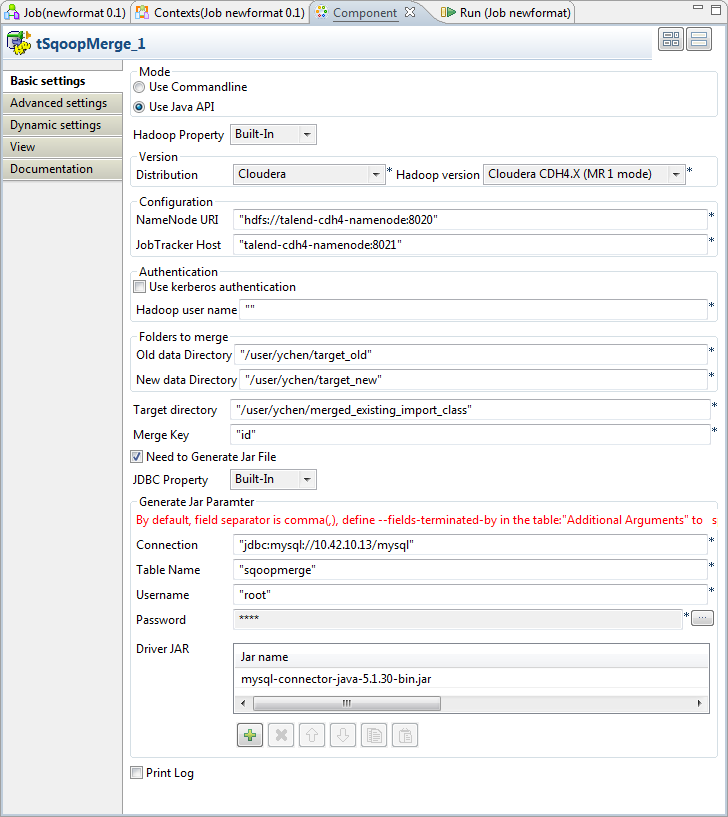
  1. Double-click tSqoopMerge to open its
    Component view.
    use_case-tsqoopmerge2.png

  2. In the Mode area, select Use Java API.
  3. In the Version area, select the Hadoop
    distribution to be used and its version. If you cannot find from the list
    the distribution corresponding to yours, select Custom so as to connect to a Hadoop distribution not
    officially supported in the Studio.

    For a step-by-step example about how to use this Custom option, see Connecting to a custom Hadoop distribution.
  4. In the NameNode URI
    field, enter the location of the master node, the NameNode, of the distribution
    to be used. For example, hdfs://talend-cdh4-namenode:8020. If you are using WebHDFS, the location should be
    webhdfs://masternode:portnumber; if this WebHDFS is secured
    with SSL, the scheme should be swebhdfs and you need to use
    a tLibraryLoad in the Job to load the library required by
    the secured WebHDFS.
  5. In the Resource Manager
    field, enter the location of the ResourceManager of your distribution.
  6. If the distribution to be used requires Kerberos authentication, select
    the Use Kerberos authentication check box
    and complete the authentication details. Otherwise, leave this check box
    clear.

    If you need to use a Kerberos keytab file to log in, select Use a keytab to authenticate. A keytab file contains
    pairs of Kerberos principals and encrypted keys. You need to enter the principal to
    be used in the Principal field and the access
    path to the keytab file itself in the Keytab
    field. This keytab file must be stored in the machine in which your Job actually
    runs, for example, on a Talend
    Jobserver.

    Note that the user that executes a keytab-enabled Job is not necessarily
    the one a principal designates but must have the right to read the keytab file being
    used. For example, the user name you are using to execute a Job is user1 and the principal to be used is guest; in this
    situation, ensure that user1 has the right to read the keytab
    file to be used.

  7. In the Old data directory and the
    New data directory fields, enter the
    path, or browse to the directory in HDFS where the older and the newer
    datasets are stored, respectively.
  8. In the Target directory field, enter the
    path, or browse to the folder you need to store the merge result in.
  9. In the Merge key field, enter the column
    to be used as the key for the merge. In this scenario, the column is
    id.
  10. Select Need to generate the JAR file to
    display the connection parameters to the source database table.
  11. In the Connection field, enter the URI of
    the MySQL database where the source table is stored. For example, jdbc:mysql://10.42.10.13/mysql.
  12. In the Table Name field, enter the name
    of the source table. In this scenario, it is sqoopmerge.
  13. In Username and Password, enter the authentication information.
  14. Under the Driver JAR table, click the
    [+] button to add one row, then in this
    row, click the […] button to display the
    drop-down list and select the jar file to be used from that list. In this
    scenario, it is mysql-connector-java-5.1.30-bin.jar.

    If the […] button does not appear,
    click anywhere in this row to make it displayed.
  15. If the field delimiter of the source table is not comma (,), you still need
    to specify the delimiter in the Additional
    Arguments
    table in the Advanced
    settings
    tab. The argument to be used is codegen.output.delimiters.field for the
    Use Java API mode or –fields-terminated-by for the Use Commandline mode.

Executing the Job

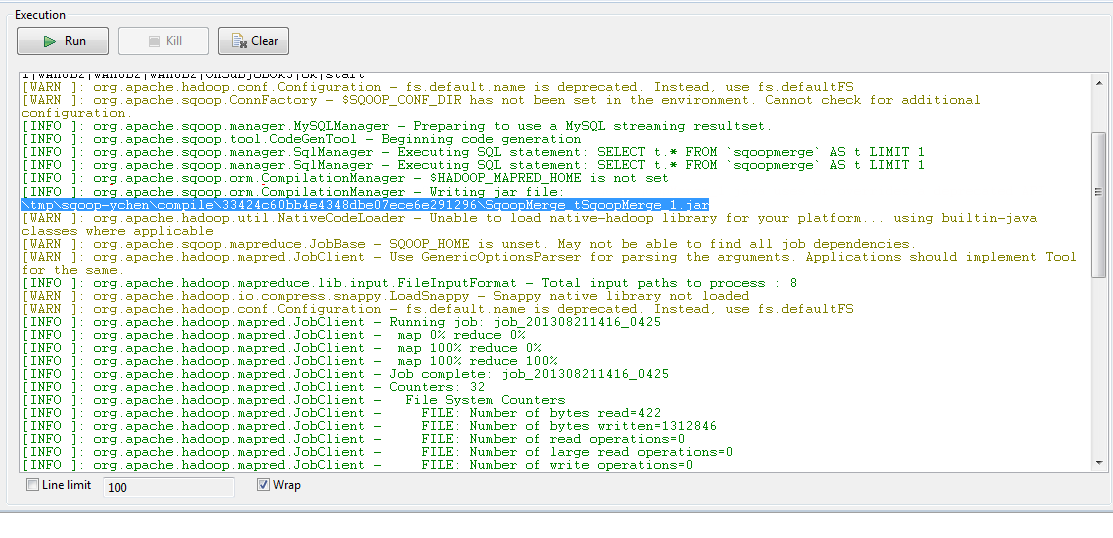
Then you can press F6 to run this Job.

During the execution, the jar file and the class for the merge are generated in
the local machine.
use_case-tsqoopmerge3.png

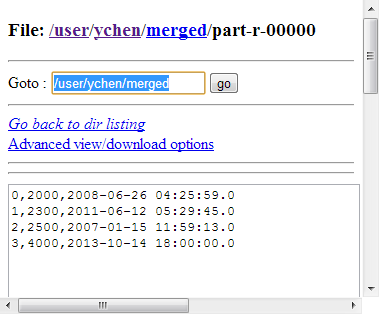
Once done, you can verify the results in the target directory you have specified,
in the web console of the Hadoop distribution used.
use_case-tsqoopmerge4.png

If you need to obtain more details about the Job, it is recommended to use the web
console of the Jobtracker provided by the Hadoop distribution you are using.

If you continue to import updated datasets to HDFS from the same source table, you
can reuse the generated merge class to merge the datasets.


Document get from Talend https://help.talend.com
Thank you for watching.
Subscribe
Notify of
guest
0 Comments
Inline Feedbacks
View all comments
0
Would love your thoughts, please comment.x
()
x