Configuring tSqoopImport
-
Double-click tSqoopImport to open its
Component view.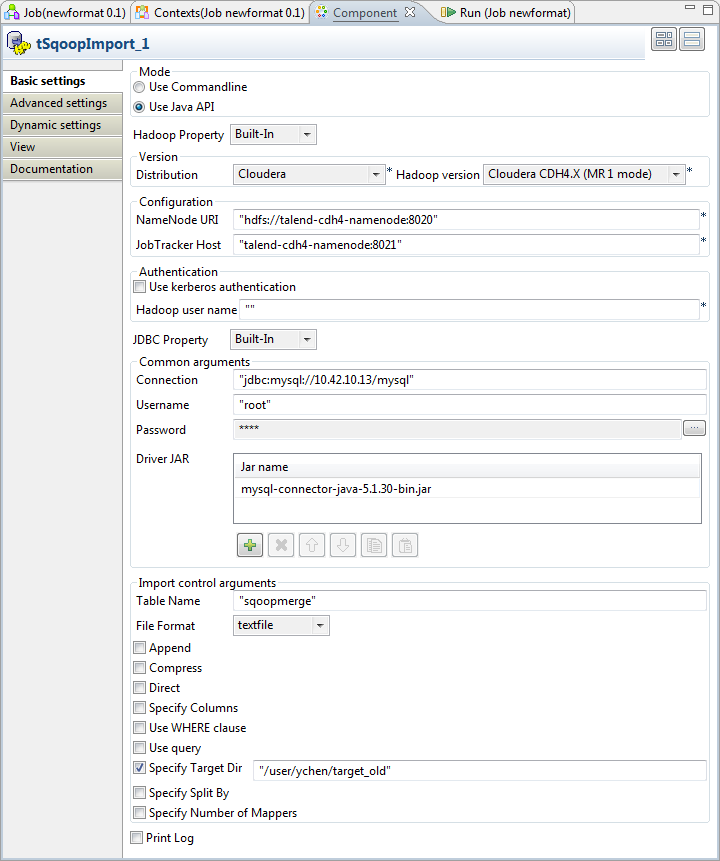
- In the Mode area, select Use Java API.
-
In the Version area, select the Hadoop
distribution to be used and its version. If you cannot find from the list
the distribution corresponding to yours, select Custom so as to connect to a Hadoop distribution not
officially supported in the Studio.For a step-by-step example about how to use this Custom option, see Connecting to a custom Hadoop distribution. -
In the NameNode URI field,
enter the location of the master node, the NameNode, of the distribution to be used.
For example, hdfs://talend-cdh4-namenode:8020. If you are using WebHDFS, the location should be
webhdfs://masternode:portnumber; if this WebHDFS is secured
with SSL, the scheme should be swebhdfs and you need to use
a tLibraryLoad in the Job to load the library required by
the secured WebHDFS. -
In the JobTracker Host field, enter the
location of the JobTracker of your distribution. For example, talend-cdh4-namenode:8021.Note that the notion Job in this term JobTracker designates the MR or the
MapReduce jobs described in Apache’s documentation on http://hadoop.apache.org/. -
If the distribution to be used requires Kerberos authentication, select
the Use Kerberos authentication check box
and complete the authentication details. Otherwise, leave this check box
clear.If you need to use a Kerberos keytab file to log in, select Use a keytab to authenticate. A keytab file contains
pairs of Kerberos principals and encrypted keys. You need to enter the principal to
be used in the Principal field and the access
path to the keytab file itself in the Keytab
field. This keytab file must be stored in the machine in which your Job actually
runs, for example, on a Talend
Jobserver.Note that the user that executes a keytab-enabled Job is not necessarily
the one a principal designates but must have the right to read the keytab file being
used. For example, the user name you are using to execute a Job is user1 and the principal to be used is guest; in this
situation, ensure that user1 has the right to read the keytab
file to be used. -
In the Connection field, enter the URI of
the MySQL database where the source table is stored. For example, jdbc:mysql://10.42.10.13/mysql. - In Username and Password, enter the authentication information.
-
Under the Driver JAR table, click the
[+] button to add one row, then in this
row, click the […] button to display the
drop-down list and select the jar file to be used from that list. In this
scenario, it is mysql-connector-java-5.1.30-bin.jar.If the […] button does not appear,
click anywhere in this row to make it displayed. -
In the Table Name field, enter the name
of the source table. In this scenario, it is sqoopmerge. -
From the File format list, select the
format that corresponds to the data to be used, textfile in this scenario. -
Select the Specify target dir check box
and enter the directory where you need to import the data to. For example,
/user/ychen/target_old.